
The Road to Wellness
Purposeful living paves the way for better health and longevity
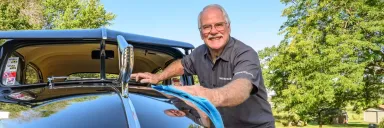
Scott Weyer was 16 when he bought his first car for a dollar. The 1959 Rambler was more a collection of parts than a car, but even at his young age, Weyer had developed a mechanical passion. He had the patience for the project and the experience of his father to guide the build.
After a year of hard work, a few mistakes and lessons learned, Weyer turned the key for the first time. Now 76, he still remembers the engine rumbling to life.
“It was exhilarating,” says the longtime Blue Cross and Blue Shield member. “Being able to be part of that process and getting that thing back on the road, it was amazing.”
Five decades later, after retiring from a fulfilling career as a machinist and maintenance supervisor at a large plant, Weyer would embark on another car build. It was the type of project he needed to keep living with purpose; a street rod he’d dreamt about for as long as he’s been able to turn a wrench. The outcome, this time five years in the making, was no less rewarding than it was at 16.
“Those feelings never go away,” he says. They’re there every time I do a project.”
Finding Meaning
For anyone who needs help finding meaning in their lives, author Richard Leider, who has written several books on purpose in life, offers a simple formula.
GIFTS + PASSIONS + VALUES = PURPOSE
| GIFTS | PASSIONS | VALUES |
| Consider your natural abilities, skills that often emerged early in your life and show up in the things you love to do. | These are things you care deeply about, that inspire and move you. | Think about the fundamental principles that guide your behavior and decisions. |
Those feelings — the ones associated with purposeful living — are also important to health and wellness. Having a sense of purpose has been shown to reduce stress, lower risk of chronic conditions, boost brain health and even help live a longer life.
A lifelong process
“A reason to get up in the morning.”
That’s the simplest way Dr. Mary Jo Kreitzer, founder and director of the University of Minnesota’s Earl E. Bakken Center for Spirituality and Healing, can describe what it means to live with a sense of purpose. It can be wide ranging — tending to a garden, walking your dog, maintaining friendships, giving back to your community or any number of other pursuits.
“Purpose is a powerful driver in our lives,” Kreitzer says. “Whatever our sense of purpose is, it really shapes and influences what we do day-to-day. And it’s important at every age and stage of life.” Purpose isn’t something you figure out once, she adds. It’s very natural for our sense of purpose to evolve throughout our lives.
For those who live purposefully, the benefits are well documented. Research published in the journal Preventive Medicine used responses from a national health and retirement study to assess the sense of purpose in roughly 13,000 adults 50 and older. Tracked over eight years, researchers found that participants with the highest sense of purpose had a 15% lower mortality risk, from any cause.
Additional studies have linked a strong sense of purpose to better cardiovascular health, reduced stress, stronger memory and greater overall happiness.
“People with a sense of purpose are more resilient. They’re able to handle the ups and downs of life and are more satisfied even while enduring challenges,” Kreitzer says. “It’s especially important as people age because they’re faced with all kinds of evolving circumstances in their lives.”
Kreitzer says that for older adults, it’s also important to think about what you can let go of and what is next — what might be calling you. If it’s overwhelming, a purpose many people embrace is simply to grow and give.
“It’s whatever gives your life meaning and joy,” she says.
Building a healthy life
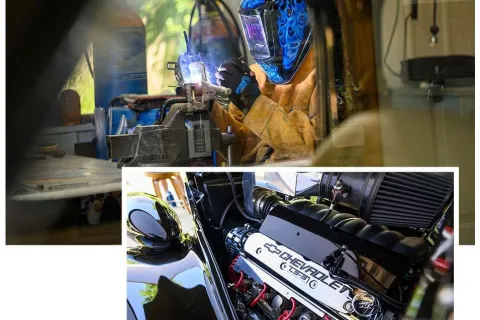
Weyer put his passion to work throughout his career as a maintenance supervisor, fabricating parts, building complex machines and keeping heavy equipment running. As he neared retirement, he had a long list of projects he was eager to take on. But retirement, at first, didn’t turn out as planned.
“That first year, I probably had 20 projects going. None of them completed. I finally decided I couldn’t do it anymore and committed to taking on one project at a time. I started putting more structure in my life and that made retirement really fun.”
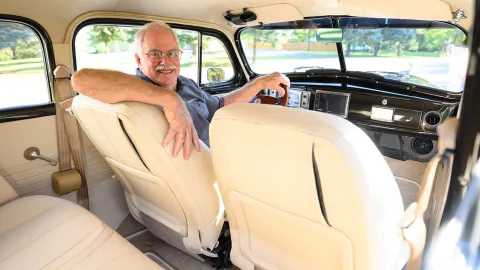
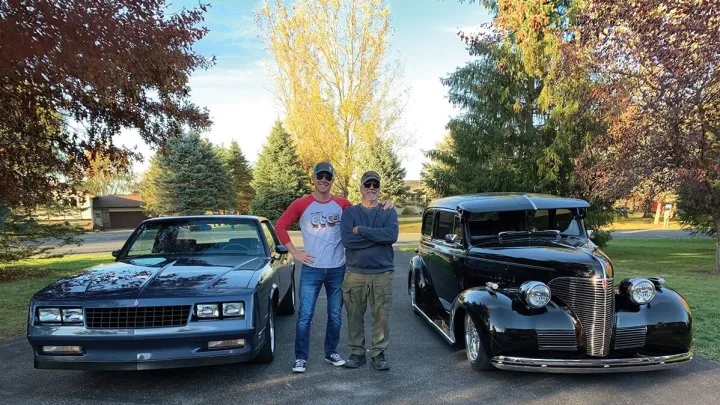
The first major project was the restoration of a John Deere tractor. After that, he focused on turning a 1939 Chevrolet Master Deluxe into his dream machine. For Weyer, that meant total disassembly, a custom frame and drivetrain, a new interior, “rootbeer” paint that shifted shades in the sun and more fabricated parts than you can count. It was an impossibly detailed build that reflected a long-developed vision. Completely his. A one of one.
A Note from the author
It’s no coincidence that the author and subject of this piece share the same name. As Scott Weyer’s son, I want to make that relationship clear and share a little bit about why I wrote this story.
I have authored features in thrive. for 10 years now and have found every one of them rewarding. I’ve met inspiring Blue Cross members throughout the state. Runners, walkers, cyclists, baseball and pickleball players, skiers, canoeists, artists and individuals engaged in so many other activities throughout Minnesota.
What connects all of these stories is how people find ways to get out, pursue their passions and live engaging, healthy lives at any age. They are our neighbors, our family members, the people we pass in the grocery store.
So many Minnesotans have an inspiring story to tell. You might have one. You undoubtedly know someone who does. My dad has one and I’m proud to share it, as it’s what inspired my own automotive hobby. I hope it encourages others to find something they love to do, and do it.
If you have a story to share, please tell us about it. You can reach me and the rest of the thrive. team at thrivemagazine@bluecrossmn.com.
Weyer estimates the car took about 7,000 hours to complete — 2,000 hours in custom machine work alone. It also involved lots of help from friends and support from family, including his wife, Mary.
The car started winning awards at shows soon after it was completed. It also expanded Weyer’s social life. He mingles with other car enthusiasts at events and also volunteers with the Minnesota Street Rod Association.
“I love talking to people about it. Telling people about how things work or how I came up with a part,” he says. “Others will come up to me to talk about their projects and I love helping them out, sharing ideas.”
Focused on the future
A year into building the car, Weyer was diagnosed with prostate cancer. Prostate removal soon followed, along with limited mobility during recovery.
But the car project motivated him to do all he could to recover quickly. He says he has always found a connection between staying active with his hobbies and maintaining his health and wellbeing.
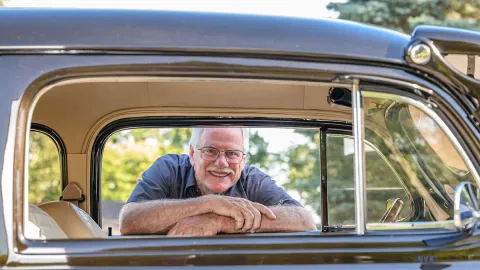
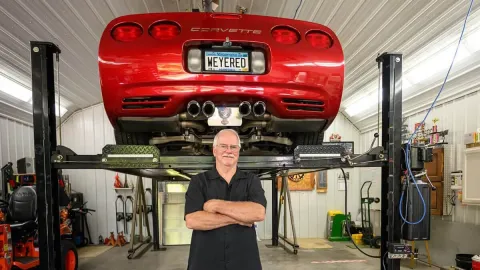
He tracks his steps and says it’s not unusual to put in 8,000 or more just walking between the house and his backyard shop, around the shop itself and the property each day. He builds on that by taking advantage of his SilverSneakers benefit, going to the local gym with Mary three times a week. He also spends a good portion of each year traveling with Mary, most recently a trip to Europe.
“There are so many ways to stay active and use your brain,” Weyer says. “I think that has a great deal to do with staying sharp and independent. I have grandkids now that I want to keep up with and that’s important to me, too.”
Weyer can often be found in the shop with those grandkids, building whatever comes to mind, passing on his passions. In recent years, putting his talents to use for others has been more of a priority than building anything for himself. That might mean doing a brake job for a friend, repairing a trailer axle for a family member or lending a hand to a fellow street rodder building their dream car.
“If I can do that, I’m happy,” he says. “It’s rewarding when people know I can help and ask me. That fills my day in a meaningful way.”
TAKE CHARGE
Need help finding purpose in your life? The University of Minnesota’s “Taking Charge of Your Wellbeing” site provides interactive resources to support your journey. Click here to learn more.


