
Employers rely on data to understand how employees use their benefits and where healthcare spending could be more efficient. The good news: There is plenty of data. The challenge lies in turning that data into actionable insights that inform decisions and yield better plan outcomes.
With a more holistic understanding of your long-term cost drivers, it’s possible to extend your planning horizon to account for emerging trends affecting employee health and your bottom line. Some examples:
- Chronic and mental health conditions account for 90% of the country’s $5.3 trillion in annual healthcare expenditures.1 In fact, 60% of adults in the U.S. have at least one chronic disease and 42% have two or more chronic diseases.2
- Treatments for rare diseases, including gene and cell therapies, are emerging for diseases such as cystic fibrosis. The treatments are generally effective, but can cost up to $4 million for certain treatments,3 with the projected cost of gene therapy coverage expected to reach $306 billion by 2034.4
- Weight loss and GLP-1 medications account for a historic rise in traditional drug spending, helping it outpace specialty drug spend for the first time.5 A one-year prescription for Ozempic at its average retail price can cost more than $12,000.6
Bring data-driven insights to life with SPARK
Blue Cross and Blue Shield of Minnesota gives you better clarity about your employees’ health needs through our Strategic Performance and Analytics Resource Kit (SPARK). Specifically built for large employer groups, this digital tool helps predict healthcare costs, distilling vast amounts of group health plan data into easily discernible, actionable information to help you reduce your total cost of care.
With advanced capabilities in AI, predictive analytics, member stratification and personalization, SPARK puts the power in your hands to tailor your strategies for ongoing success.
See what’s coming — before it hits
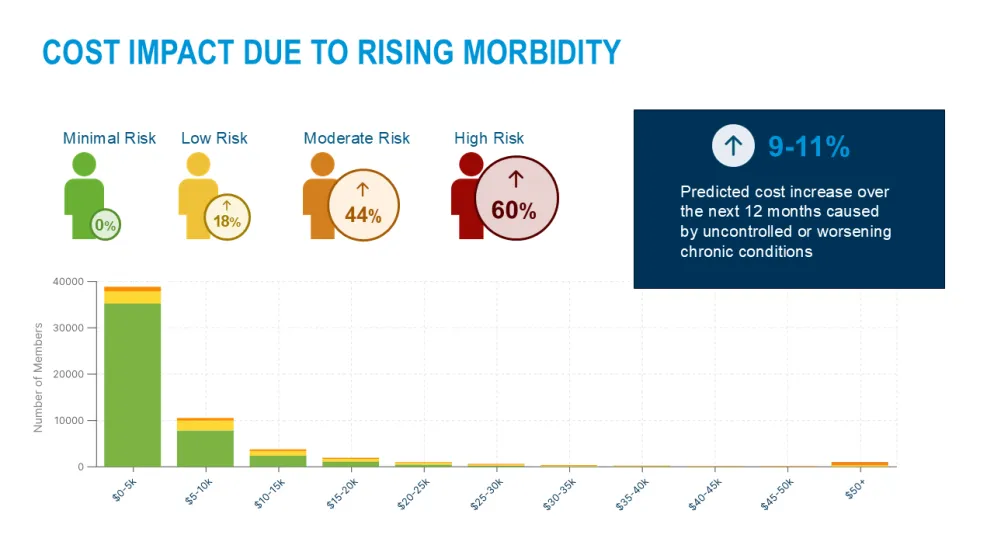
SPARK integrates 39 data sources and uses 13 predictive models to provide a forward‑looking, 12‑month forecast of healthcare costs. It gives employers with large, complex populations early visibility into what’s ahead. By combining claims, laboratory results and key demographic factors, SPARK anticipates cost trends caused by rising morbidity from uncontrolled or worsening chronic conditions.
Integrating comorbidities, age and clinical history enhances accuracy and enables more confident planning and decision‑making. Most important, SPARK identifies early the members who are at elevated risk, creating opportunities for proactive case management and personalized interventions that can improve outcomes and mitigate future costs.
Focus on dollars you can influence
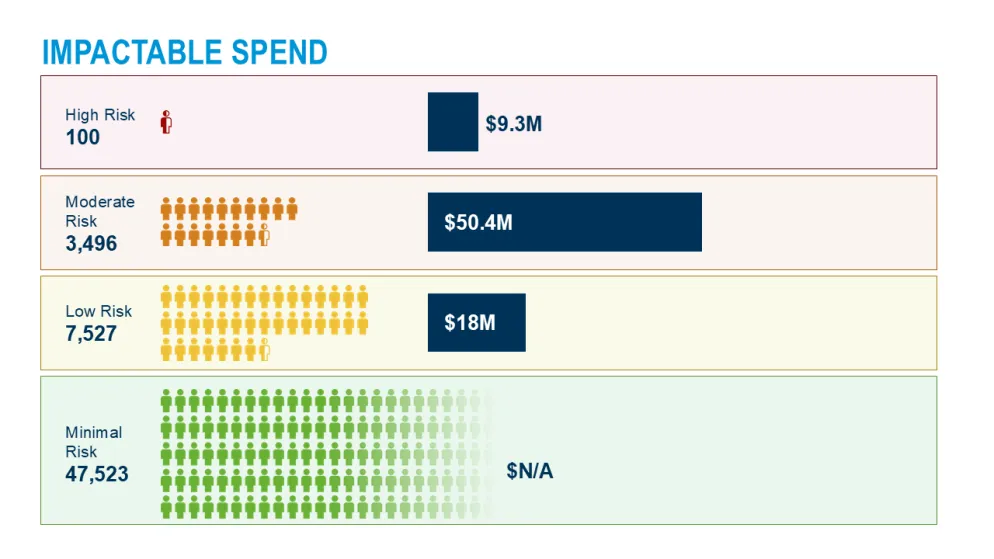
At the core of SPARK’s models is a sophisticated methodology designed to quantify impactable spend, the portion of healthcare costs that can be meaningfully reduced or avoided through targeted clinical and operational interventions. These are the dollars that matter most: areas where focused action has a proven, evidence‑based opportunity to improve outcomes while lowering the total cost of care.
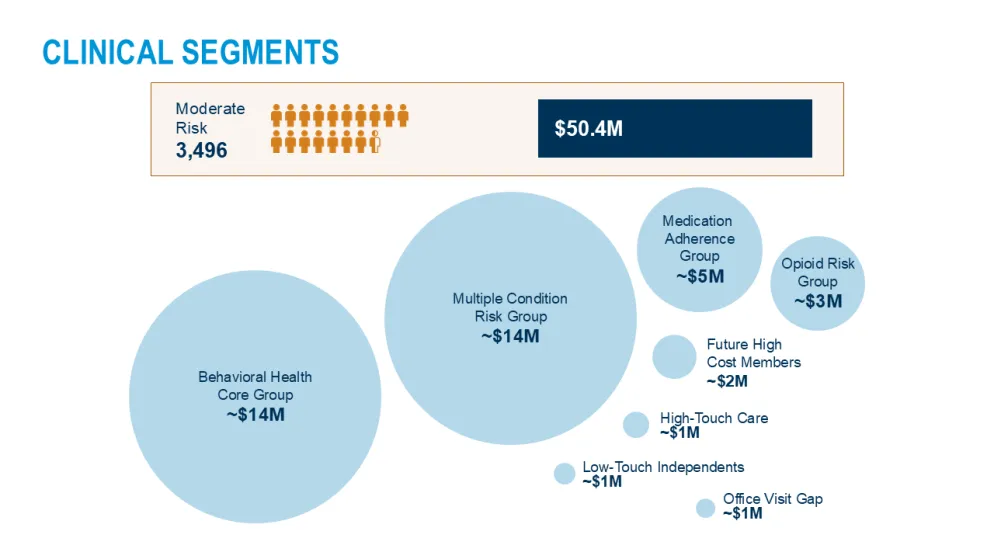
SPARK deepens this insight by breaking down impactable spend into clear strategies. The population is segmented into clinically relevant groups within each risk tier, creating manageable, high‑opportunity cohorts. Larger populations give the models the data depth needed to make cohort-level forecasts statistically reliable. These clinical segments bring together members with shared needs — enabling more precise, personalized interventions and supporting smarter, more effective care strategies at scale.
Turn insight into action
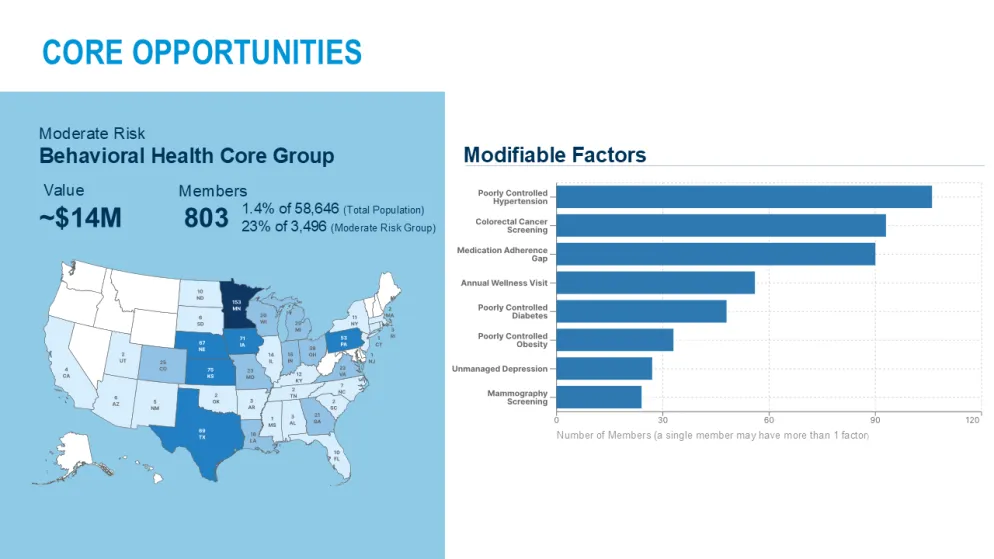
The final layer of the tool empowers users to dynamically explore the data and pinpoint high-impact, personalized intervention opportunities.
By spotlighting uncontrolled conditions, missed screenings and medication adherence gaps, the tool transforms complex data into clear opportunities for action. Persona-driven insights reveal where tailored strategies can facilitate the greatest return, such as customized outreach for time‑constrained caregivers or seamless digital engagement through Blue Care AdvisorSM for members who prefer self‑service experiences. Incorporating geographic data creates more precise approaches, distinguishing urban and rural needs to optimize reach and relevance.
SPARK goes beyond forecasting what the future may hold. It gives employers the clarity, confidence and direction to shape better outcomes by acting on those insights today.
Enhance plan value through SPARK insights
Blue Cross is dedicated to increasing member satisfaction, enhancing care delivery and controlling the total cost of care through innovation. Using predictive analytics, SPARK translates raw data into holistic and discernible insights — enabling employers to identify specific opportunities to improve employees’ health and increase savings.
Whether insights are used to reach members who need critical preventive care or to increase engagement and early intervention for members at risk due to chronic conditions, employers have more comprehensive information. They can make informed decisions for their employee population and take proven steps to reduce overall plan costs.
Empowering employers with predictive cost insights through advanced analytics is just one part of our trusted AI strategy. Learn more about how impactful innovation and AI from Blue Cross are unlocking even greater healthcare value for employers and members.
SPARK availability varies by group size and funding arrangement. Your account representative can confirm if the current version of SPARK is a fit for your plan.
Connect with us
SVG
Let's work together
Give us a call: 1-877-293-7035 (TTY 711)
Not already working with Blue Cross? Check out our plans and resources for large and small groups.
SVG
Subscribe to Insights & Updates
Keep tabs on what's new and what's changing in the healthcare industry.
1“Fast Facts: Health and Economic Costs of Chronic Conditions,” Centers for Disease Control and Prevention, May 2026.
2Benavidez GA, Zahnd WE, Hung P, et al. “Chronic Disease Prevalence in the U.S.: Sociodemographic and Geographic Variations by ZIP Code Tabulation Area,” Centers for Disease Control and Prevention, February 2024.
3Puiu, Tibi. “Life-Saving Treatment for Children Worth $4.25 Million Is World’s Most Expensive Drug,” ZME Science. March 2024.
4Young, CM, Quinn, C, Trusheim, MR. “Durable Cell and Gene Therapy Potential Patient and Financial Impact: U.S. Projections of Product Approvals, Patients Treated, and Product Revenues,” Drug Discovery Today, 27(1):17–30, January 2022.
5Mayer, Kathryn. “GLP-1s Now ‘Predominant Driver’ of Drug Spend Growth,” SHRM, April 2025.
6Aungst, C. “How Much Ozempic Costs Without Insurance — and 6 Ways to Save,” GoodRx, reviewed July 2026.