Impactful innovation
A trusted AI strategy for proven healthcare value

A trusted AI strategy for proven healthcare value
As artificial intelligence continues to dominate conversations across industries, many employers are asking a simple and practical question: How can AI create measurable value without increasing risk, complexity or costs?
In healthcare, where rising expenses, fragmented data and regulatory requirements create unique challenges, successful AI adoption requires more than experimentation. It demands a disciplined strategy built on trust, governance and outcomes.
Blue Cross and Blue Shield of Minnesota has embraced that philosophy by taking a deliberate, values-driven approach to AI deployment. Rather than pursuing thousands of AI use cases, Blue Cross applies AI through purpose-built solutions that lower overall costs, reduce friction, strengthen transparency and achieve key healthcare outcomes.
Healthcare costs continue to rise faster than inflation,1 placing more and more pressure on employers as they seek sustainable ways to manage benefit expenses.
At the same time, advances in AI and predictive analytics are creating new opportunities for health payers to use data to streamline operations, enhance employer decision-making and personalize experiences for members. Research suggests breakthrough AI adoption could significantly combat healthcare costs over the next 15 years.2
But there are significant barriers to effective AI implementation:
For Blue Cross, these realities reinforce an important principle: Successful AI deployment begins by evaluating where it can provide real value rather than rushing to roll out new tools.
The Blue Cross AI strategy follows a values-driven approach.
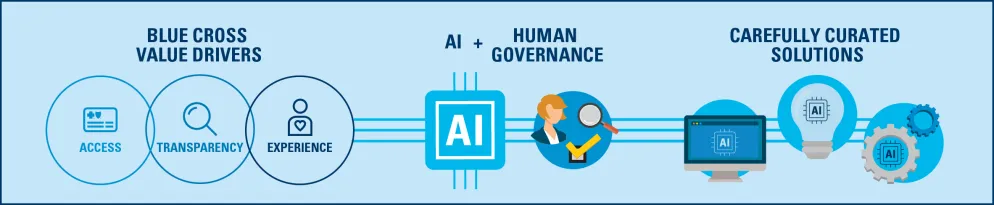
Every AI opportunity must align with the key value drivers at the heart of the trusted Blue Cross operating model: better access, transparency and experience. These value drivers have been proven to lower the total cost of care for employers3 and deliver a preferred experience for members.4
Following this approach means AI solutions from Blue Cross remain rooted in a broader mission of helping members live their healthiest lives.
It’s an important shift from organizations that take a technology-first approach. By focusing on real-world problems, AI investments are tied to tangible business and member outcomes rather than innovation for innovation’s sake.
Successful and scalable AI starts with a firm data foundation.
Risks arise when health payers rush into large-scale AI initiatives that require significant technology investments and complex integrations across platforms and systems. At Blue Cross, connected data and governance come first.
Before implementation begins, AI initiatives move through a disciplined process that assesses business value, expected outcomes and human accountability. Throughout the process, AI never replaces human decision-making. Blue Cross thought leaders and experts are at the center, harnessing AI as a tool that operates within the bounds of their oversight and clearly defined guardrails.
Rather than launching large numbers of AI pilots or pursuing widespread implementation without clear evidence, Blue Cross identifies carefully curated solutions that demonstrate measurable results.
AI is used where it can remove barriers to care, support proactive decision-making and improve operational efficiency. Each initiative is measured against defined key performance indicators, with oversight in place throughout implementation and optimization.
Today, employers and employees are experiencing the benefits of Blue Cross AI and advanced modeling solutions in three key areas: simplified member navigation, predictive cost insights and next-generation operations.

Blue Care AdvisorSM: all-in-one digital experience for members that uses AI to analyze data and segment registered members into 150-plus clinically validated groups
Blue NoteSM and Lumena: AI-powered tools that create service efficiencies for members as they work with Blue Cross teams
44% of registered Blue Care Advisor users closed a care gap vs. 32% of unregistered members, and self-insured clients avoided $6.5 million in costs through care gap closures last year5
Blue Note saved members 54 seconds per call with Member Experience Advocates, and Lumena saved 5 minutes and 45 seconds per Case Manager call last year6

SPARK (Strategic Performance and Analytics Resource Kit): uses predictive models and personas to identify rising-risk members and forecast costs to guide tailored outreach
SDOH Intelligence: uses machine learning and predictive modeling to show how social factors influence an employer’s population health
12 months of impactable spend forecasted through SPARK, featuring 39 data sources and 13 predictive models6
$1,012 PMPY average anticipated savings through targeted SDOH interventions6

Auth AI: speeds up prior authorization approvals to provide a better experience for members and providers — AI is never used to deny prior authorization requests
Payment Integrity AI: helps detect emerging coding patterns, shifts in documentation behavior and market-level trends to combat AI coding intensity
65% of qualified prior authorization requests were handled by Auth AI, and 60% were approved within 5 minutes, with 80% approval targeted in 20277
100% of claims are reviewed annually by our payment integrity program, with an estimated $424.5 million in annual savings8
Trust in AI is not earned through the sheer volume of deployments a partner releases but by how effectively technology is used to solve real problems. Through a disciplined, mission-driven framework, Blue Cross uses AI to make healthcare more sustainable and more valuable for employers.
Blue Cross AI solutions are purpose-built to lower overall costs, reduce friction, strengthen transparency and achieve key healthcare outcomes that matter most for employers and members.
To learn more, check out our impactful innovation webpage or connect with your Blue Cross representative.
Give us a call: 1-877-293-7035 (TTY 711)
Not already working with Blue Cross? Check out our plans and resources for large and small groups.
Keep tabs on what's new and what's changing in the healthcare industry.
1“Behind the Numbers 2027,” medical cost trend, PwC, June 2026.
2Eitelwein O and Duong DB. “Unlocking the Great Health Productivity Reset,” Oliver Wyman, March 2026.
3“Singleton A, Tilley C, Rachlin S. “Milliman Analysis of Total Cost of Care Benchmarks,” March 2025.
4Market insights, Blue Cross Brand Strength Measure Survey, Blue Cross Blue Shield Association, 2025.
5Blue Care Advisor data, 2025.
6Blue Cross and Blue Shield of Minnesota internal data, 2025.
7Blue Cross and Blue Shield of Minnesota internal prior authorization data.
8Blue Cross and Blue Shield of Minnesota claims that undergo payment integrity advanced coding review. Annual gross savings CY2025 (commercial fully insured and self-insured accounts).